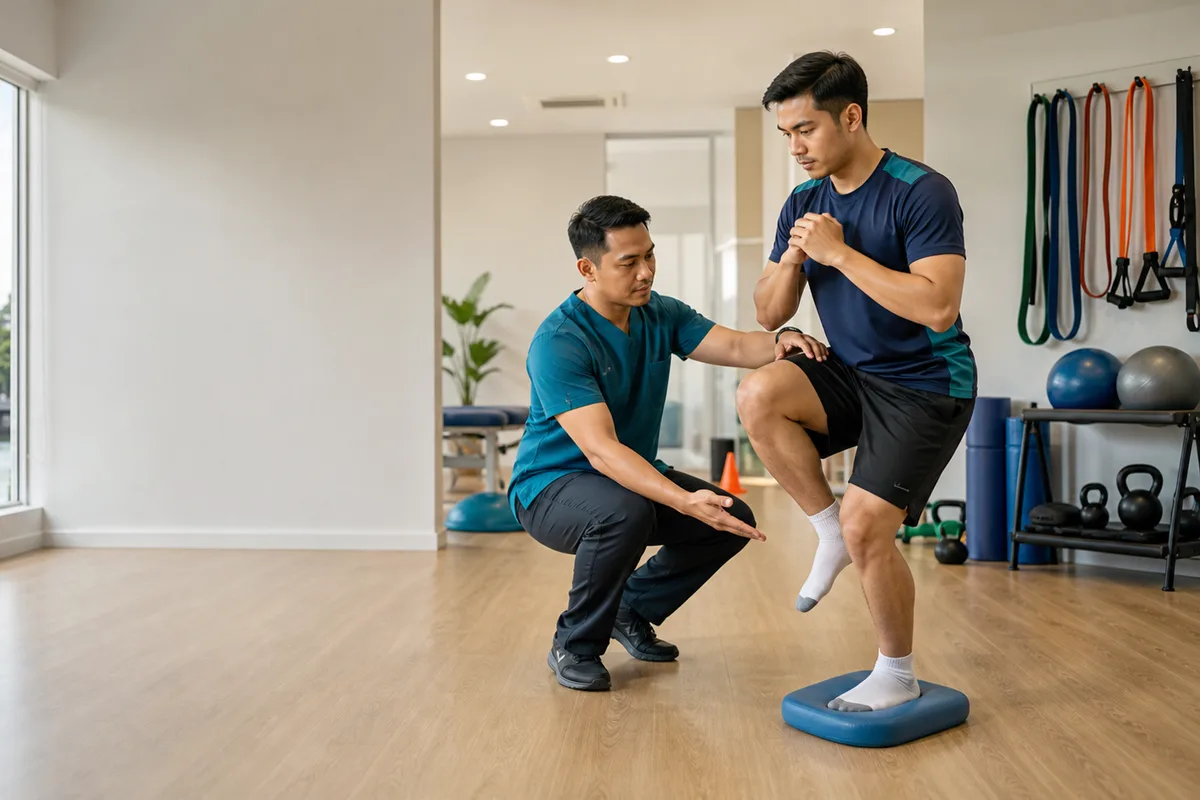
Knee Pain Physiotherapy in Johor
Knee pain is the second most common reason patients message PhysioJohor - right after the lower back.
Unlike the back, though, "knee pain" is not one condition.
It is at least a dozen patterns that look similar on the outside but need very different physiotherapy.
Patellofemoral pain responds to loading changes. A meniscus tear with a locked feeling responds to targeted joint work.
Post-ACL surgery needs a structured neuromuscular programme. Early osteoarthritis in a 55-year-old Johor aunty responds to strengthening and weight management.
Matching the right physio to the right pattern is most of the game.
What is knee pain and do I need a physio?
Knee pain is pain in, around, or behind the knee joint, and it can come from bone, cartilage, ligaments, tendons, or surrounding muscles.
A physiotherapy assessment is usually the most efficient first step: we can screen for red flags (locked knee that will not straighten, gross instability, severe swelling after trauma, fever with joint pain) that need orthopaedic or emergency care, and we can tell you within one or two sessions whether rehab alone is likely to fix you or whether you need an MRI and a surgeon's opinion first.
How much does knee physio cost in Johor Bahru?
Typical Johor rates: RM120-250 per session.
Higher-tier Iskandar Puteri and Medini clinics sit at the top end; Skudai, Kulai, Kluang, Muar and Batu Pahat usually at mid-range.
A realistic full course of 6 to 10 sessions lands between RM 720 and RM 2,500.
How long does knee recovery take?
For mechanical, non-post-surgical knee pain, most patients see meaningful improvement by session 3 to 4, with return to normal function by session 8 to 10 over 6 to 10 weeks.
Return-to-sport timelines are longer: patellofemoral runners are usually back to 5K at week 6 to 8, ACL-reconstructed athletes at 6 to 9 months.
Is physio right for you?
- Your knee hurts during specific activities (stairs, running, squatting, sitting for a long time).
- You have swelling but no locking or giving-way.
- Pain has lasted more than two weeks or keeps coming back.
- You have not had major trauma in the last week - if you did, see a doctor first.
- You are willing to do the home programme.
What happens at your first session
- Detailed history - what you do, when it hurts, what helps, any past injuries or surgeries.
- Physical examination - swelling, range of motion, specific tests (Lachman for ACL, McMurray for meniscus, patellar compression, single-leg squat).
- Working diagnosis in plain language.
- Initial treatment: manual therapy where indicated, guided loading, 2–3 home exercises.
- A realistic session plan with milestones at session 3 and session 6.
Outcome milestones
- Week 2 (session 2–3): 30–50% reduction in activity-related pain. Stairs feel easier.
- Week 4 (session 4–6): Normal walking, light jogging if the pattern allows. Strength noticeably improving.
- Week 6–8: Return to sport-specific drills for athletes; activities of daily living fully restored for most others.
- Month 3 and beyond: Ongoing maintenance exercise 3–4 times a week to prevent recurrence.
Johor-specific considerations
Post-surgery knee cases from Johor hospitals - KPJ Johor Specialist, Regency, Columbia Asia Iskandar, Gleneagles Medini and HSA Sultanah Aminah all do knee replacements and ACL reconstructions. Each has its own protocol timing - we match you to a physio with post-op experience specific to your surgeon's preferences.
Industrial / SOCSO knee cases - Pasir Gudang, Senai, Tanjung Langsat factory workers with lifting or slip injuries: SOCSO panel physios cover treatment if you file within 60 days.
Singaporeans - many JB patients are runners or gym-goers from Singapore looking for quality knee rehab at 55–65% lower cost. The cadence works well - weekly sessions with a matched physio for 6–10 weeks.
When knee pain is not a physio case
- Knee locked in a bent position and will not straighten.
- Severe swelling and inability to bear weight after trauma.
- Red, hot, swollen joint with fever - possible infection, emergency.
- Gross instability immediately after an injury (likely ACL + other structures).
Go to HSA Sultanah Aminah, KPJ Johor Specialist, HSI, or your nearest emergency department for these.
How PhysioJohor matches you
WhatsApp us.
A practising physio asks about your activity, when it hurts, any imaging you have, and what you are trying to get back to.
We match you to a physio in our Johor network who treats your specific knee pattern - sports-oriented, post-op specialist, geriatric-friendly, or SOCSO-familiar - in the language you prefer, near your home or workplace.
Reviewed by M. Thurairaj, registered physiotherapist.