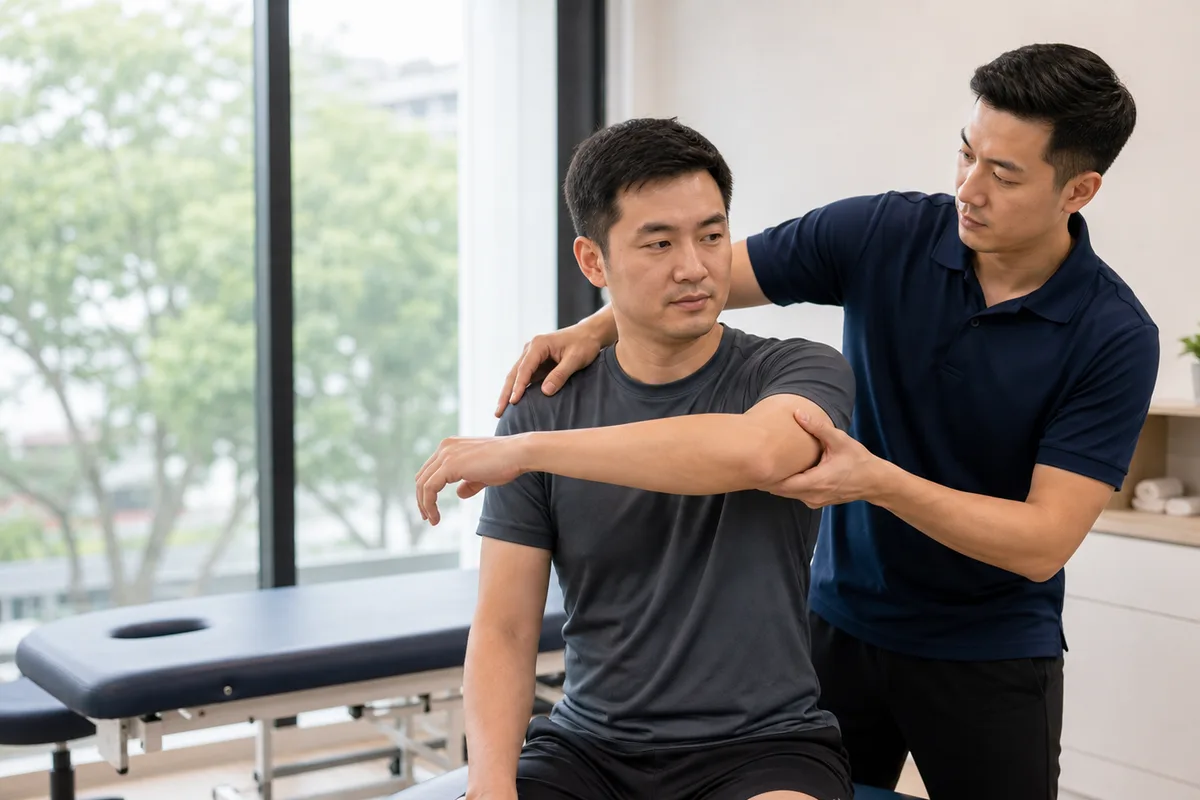
Rotator Cuff Injury Physiotherapy in Johor
The rotator cuff is four small muscles - supraspinatus, infraspinatus, teres minor, subscapularis - that hold the ball of the shoulder joint stable against the socket.
When one or more gets inflamed, tendinopathic, partially torn, or fully torn, the outcome is a spectrum from mild niggles when lifting overhead to frank weakness and pain that wakes you at night.
The important clinical point: a torn rotator cuff on MRI does not automatically mean you need surgery.
Most partial tears and many full-thickness tears in the 55+ population do extremely well with a well-programmed rehab course.
Acute, traumatic full tears in younger active patients are the main surgical indication.
What physio actually targets
- Inflammation and pain control in the acute phase.
- Progressive loading of the cuff and scapular stabilisers - this is the central mechanism of recovery.
- Restoration of overhead movement pattern - including thoracic mobility and scapular control.
- Graded return to the activity that brought you in (swimming, badminton, lifting, work overhead).
How much does rotator cuff physio cost in Johor?
Typical: RM120-250 per session.
A realistic course of 10–14 sessions over 8–12 weeks runs RM120-250.
Timeline expectations
- Weeks 1–2: Pain reduction, protect the joint from aggravating positions.
- Weeks 3–6: Progressive loading begins, scapular control, early overhead drills.
- Weeks 7–10: Return to 80% of normal function for most.
- Weeks 10–16: Return to sport or heavy occupational use for higher-demand patients.
Post-surgical repair (if your orthopaedic specialist at KPJ Johor, Regency, Gleneagles Medini or Columbia Asia Iskandar recommended it) follows a different 4–6 month protocol - see our post-rotator-cuff-repair page.
Is physio right for you?
- Shoulder pain with specific movements (reaching up, behind back, across body).
- Weakness noted when doing overhead chores, or during sport.
- No acute trauma in the last 72 hours (if yes, see a doctor first).
- Pain disturbs sleep - commonly lying on the affected side.
Johor-specific considerations
Industrial workers (Pasir Gudang, Senai, port): rotator cuff injuries from repetitive overhead work are classic SOCSO cases. Panel physios handle these.
Active seniors / badminton players in JB and Kulai - very treatable with 10–12 sessions plus serious home load work.
Post-surgical patients from KPJ Johor, Regency, Gleneagles Medini, Columbia Asia Iskandar - your surgeon's protocol drives the rehab timeline; we coordinate.
When to escalate
- Sudden loss of strength after a fall or sudden loading - may indicate a new full tear.
- Progressive weakness during rehab rather than improvement.
- Night pain unresponsive to 4+ weeks of good physio.
How PhysioJohor matches you
WhatsApp us with: where the pain is (front, side, back of shoulder), what movements trigger it, whether there was trauma, and whether you've had imaging.
We match to a shoulder-experienced physio near you.
Reviewed by M. Thurairaj, registered physiotherapist.