Stroke Rehabilitation in Johor
Stroke rehabilitation is unlike most physiotherapy. It is not about fixing one painful structure - it is about retraining a brain.
What matters is matching the right intensity to the right stage, and staying with the programme long enough for the nervous system to lay down real new patterns.
The families we see often come through a similar journey.
Someone has a stroke, spends 5 to 10 days at HSA Sultanah Aminah, HSI, KPJ Johor Specialist, Regency or Gleneagles Medini, receives a short burst of in-patient physiotherapy, and is then discharged home with a printed sheet of exercises and a blurry sense of what to do next.
This page is about what happens from that point forward.
What stroke rehab actually involves
Modern stroke rehabilitation is task-specific, intensive, and repetitive.
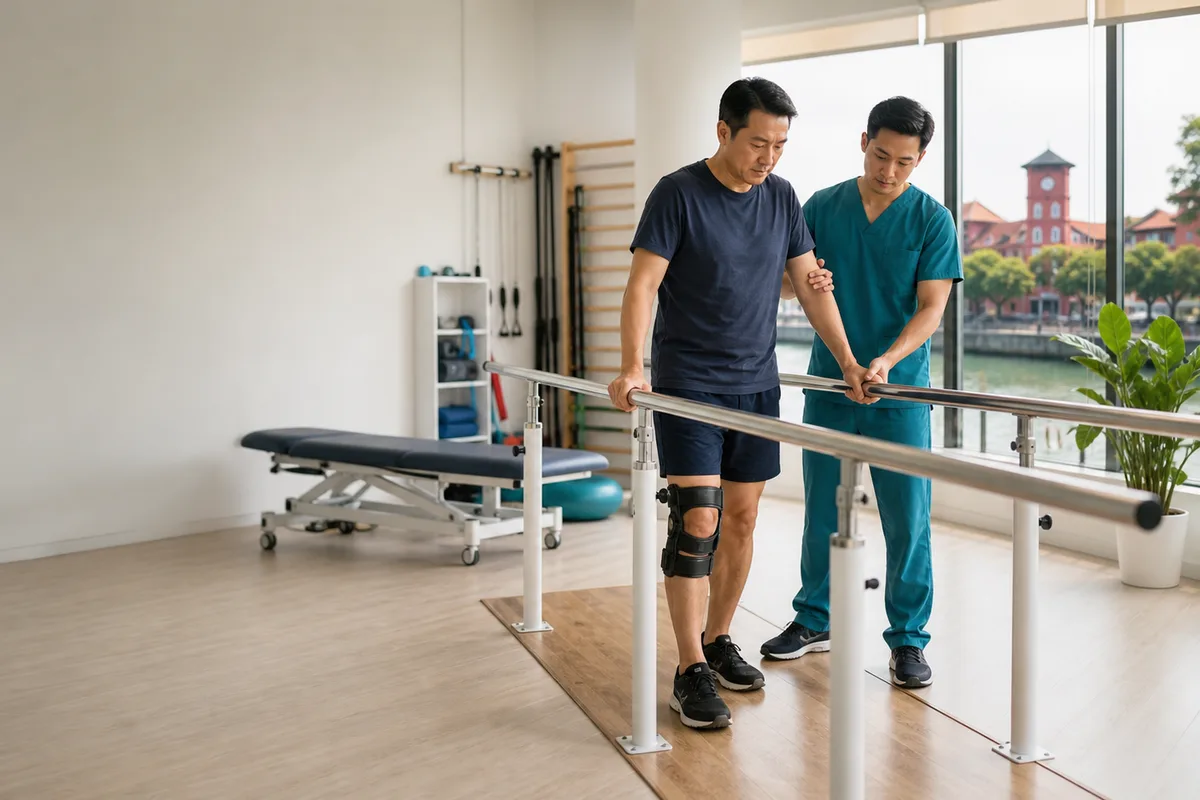
Watching a physio work with a stroke patient looks simple - "just practising walking" or "just squeezing a soft ball" - but the clinical skill is in how the task is set up, the progression rate, the cueing, and the safety.
In the acute and subacute phases (weeks 1 to 12), we focus on regaining usable movement: sit-to-stand, safe transfers, first steps with support.
In the chronic phase (month 4 onwards), we shift to adapting daily activities and maintaining what has been gained, while still pushing gradual improvements in balance, gait quality, and hand function.
How much does stroke physio cost in Johor?
Clinic-based neuro physio sessions in Johor run RM120-250 each.
Home-visit sessions - often essential in the first few months - run RM120-250 depending on travel distance and session length.
Most families find 2 sessions a week plus daily family-led practice more effective than 3 sessions a week without home carryover.
A realistic monthly cost for the first 6 months is RM 1,500 to RM 2,500.
How long does recovery take?
The fastest gains happen in the first 3 months, when neuroplasticity is at its peak.
Most patients continue to improve meaningfully up to 12 months with consistent rehab, and measurable gains (especially in gait, balance, and hand function) are possible for years afterwards.
The right question is not "how long until recovery" but "what function are we working on next."
Is this the right support for your situation?
- The patient is medically stable (blood pressure, heart rhythm, seizures, swallowing) - confirmed by the discharging doctor.
- You want a consistent physio, not a rotating cast.
- Home-visit access is needed early on, or the family can bring the patient to a clinic.
- You are willing to do daily family-led practice between sessions - this is half of the outcome.
What happens at the first session
Expect 60 to 90 minutes.
The physio will take a detailed history (where the stroke affected movement, speech, swallowing, cognition), review discharge paperwork, and test: muscle tone, active movement, sensation, balance, gait (or sit-to-stand if gait is not yet safe).
They will then set 2 or 3 immediate priorities - usually safety first (preventing falls), then one mobility goal and one hand-function goal.
Family members are coached on safe transfers and daily practice from day one.
Milestones for a typical case
- Month 1: Safe sitting balance, supervised transfers, first assisted steps.
- Month 3: Walking indoors with or without a walking aid, basic hand reach and release patterns.
- Month 6: Community-distance walking for many patients, functional daily tasks (feeding, dressing) with adaptation.
- Month 12 and beyond: Ongoing gains in endurance, gait quality, fine motor skill, balance confidence.
Johor-specific considerations
Hospital discharge pathway. We help coordinate with the physio team at HSA Sultanah Aminah, HSI, KPJ Johor, Regency, Columbia Asia Iskandar, and Gleneagles Medini - you do not have to repeat the whole history at the first outpatient session because we provide a brief.
Language matters more here than in any other condition. Stroke rehab involves frequent verbal cueing, correction, and encouragement.
A Mandarin-speaking elderly parent recovering a motor skill needs a Mandarin-speaking physio, not an English-only one with a translating app.
We match carefully on language - Mandarin, Hokkien, Cantonese, Bahasa Malaysia, Tamil, or English.
Home-visit logistics. We regularly see patients in JB city, Iskandar Puteri, Skudai, Johor Jaya, Permas Jaya, Taman Molek, Mount Austin, and Kulai for home-based neuro rehab. Outside the JB district, home visits can be arranged case-by-case.
When stroke rehab is not the right next call
If the patient is having new stroke symptoms (sudden weakness, slurred speech, facial drooping, severe headache), that is an emergency - call 999 or go to A&E immediately.
If swallowing is deteriorating, if blood pressure is unstable, or if there are new seizures, the medical team needs to review first before a rehab session is safe.
How PhysioJohor matches you
WhatsApp us.
Tell us roughly when the stroke happened, which side is affected, where you are in Johor, what language the patient prefers, and whether you need home or clinic visits.
A practising physiotherapist responds, asks 3 to 5 clinical questions, and matches you to a neuro-trained physio in our Johor network - experienced, patient, and in the right language.
Reviewed by M. Thurairaj, registered physiotherapist.