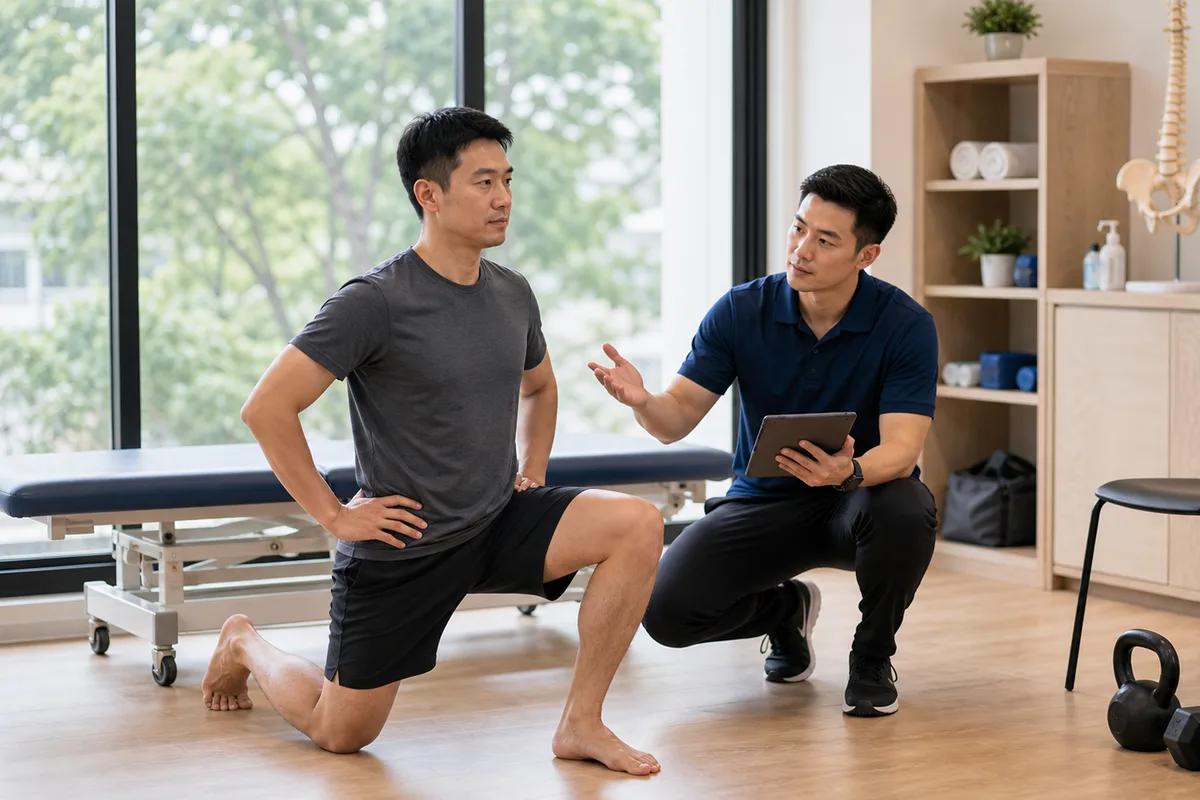
Gait Training Physiotherapy in Johor
Gait training is what we do when the way someone walks or runs is the direct cause - or the sustaining factor - of their injury, pain, or fall risk.
It covers three distinct populations: runners with recurrent overuse injuries, neurological patients relearning walking after stroke or with Parkinson's, and elderly patients whose gait changes are pushing their fall risk into the red.
For runners - cadence, posture, and contact
The highest-value running retraining variables are cadence (step rate), over-stride, and trunk lean.
Most recurrent shin, knee and hip injuries improve when cadence comes up to 170–180 spm and the over-striding reduces.
We film you on a treadmill or outdoors at Iskandar Puteri parkrun, measure it, coach specific cues, and test again 4–6 weeks later.
The change is measurable, not "how does it feel".
For neurological patients - task-specific and high-repetition
Post-stroke gait training is not generic walking practice.
It's specific cue-rich work: stepping to a line, over an obstacle, around a cone, with a weight shift.
Task-specific training plus repetition plus feedback is what the evidence supports. Body-weight-supported treadmill training and rhythmic auditory cueing are useful adjuncts where available.
For the elderly - gait as fall-risk biomarker
Slow gait, short step length, poor dual-tasking under distraction are each independent predictors of falls.
We screen them, target the modifiable ones, and coordinate with the family GP for medication review where appropriate.
Cost and Johor context
RM120-250 per session (gait analysis often billed as a longer first session). We've worked with runners, post-stroke patients, and elderly fallers across Iskandar Puteri, JB central, Skudai and Kulai - the running analysis is also popular with Singaporean runners who cross over for longer training surfaces.
How PhysioJohor matches you
WhatsApp us: which population fits you (runner, post-stroke, elderly), specific concerns, and any previous gait or biomechanics analysis done.