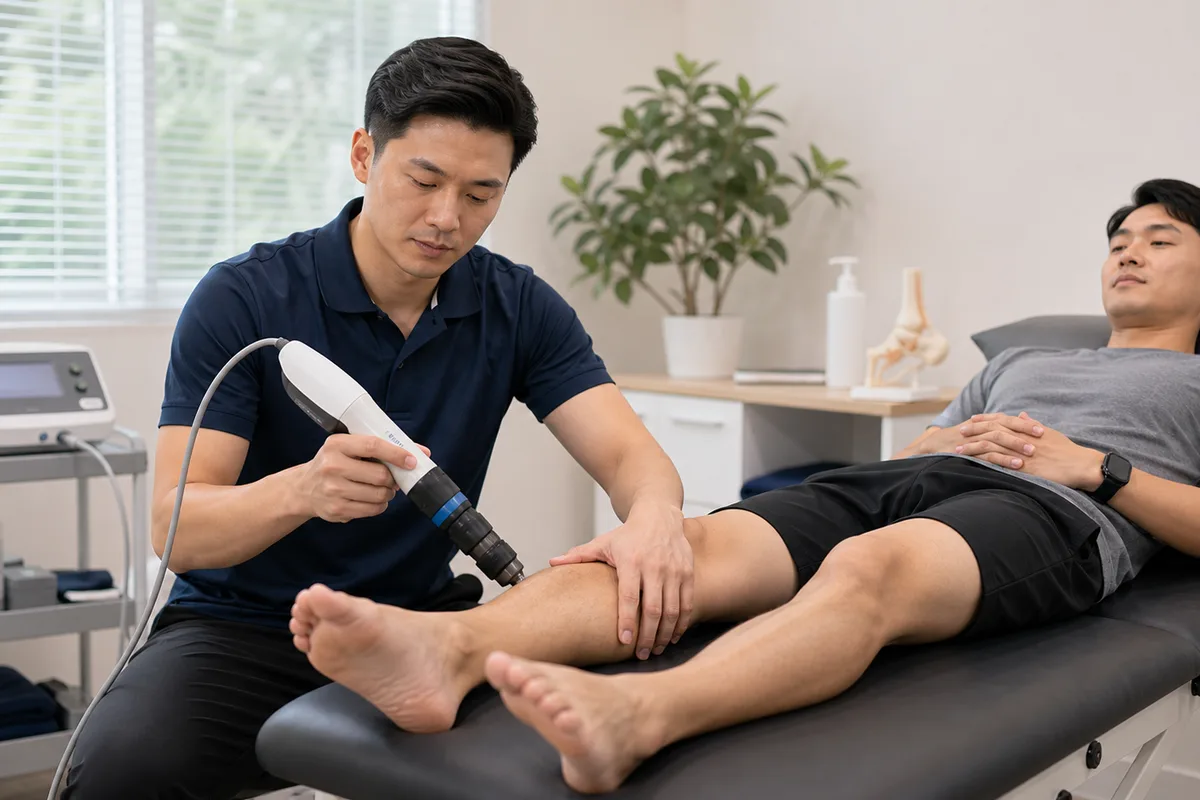
Electrotherapy in Johor
"Electrotherapy" is not one thing.
It covers transcutaneous electrical nerve stimulation (TENS) for pain gating, neuromuscular electrical stimulation (NMES) for muscle re-education after surgery or stroke, and interferential current (IFC) for deeper pain zones.
Each has different mechanisms, different evidence bases, and different places where it helps or doesn't.
Used correctly, they're useful adjuncts. Used as a stand-alone treatment, they rarely change outcomes.
When each is genuinely useful
TENS - short-term pain relief during active rehab, labour pain, some neuropathic conditions.
Effect is temporary, and it works by closing the "pain gate" at spinal-cord level, not by fixing tissue. NMES - quadriceps atrophy after ACL or knee replacement; shoulder re-education after rotator cuff repair; foot drop after stroke.
This is the category with the strongest rehab-specific evidence, because it actually helps recruit muscle the patient can't yet recruit voluntarily. IFC - subacute back or neck pain where deeper stimulation is wanted and TENS feels too superficial.
Modest evidence; useful as comfort while loading builds.
When it's a distraction
If a clinic billing you for "machine treatment" three times a week for eight weeks, and not much else - whatever box the pads come out of, the plan isn't right.
Passive electrical stimulation does not remodel a tendon, does not make a stroke patient walk, does not close a diastasis.
Those take loading, repetition, and specific skill drills.
How we use it
Pad placement, frequency, and intensity are tuned to the goal.
For NMES after knee surgery, we check visible contraction of quads before the patient leaves - if we can't see the muscle fire, the setting is wrong.
For TENS, we teach the patient to use it at home between visits so sessions aren't spent plugged into a machine.
Cost and Johor context
RM120-250 add-on per session. Most Johor public hospitals (HSA Sultanah Aminah, HSI, HSA Batu Pahat, Kluang, Muar) use electrotherapy in their physio departments, usually bundled into a session fee.
Private clinics charge per modality.
We are transparent about when it is and isn't earning its place in your plan.
How PhysioJohor matches you
WhatsApp us: your condition, and whether previous treatment has been mostly "machines" or mostly hands-on and exercise.
We recommend accordingly.
Reviewed by M. Thurairaj, registered physiotherapist.